



CAHN Club and the starting line breakthrough

13/08/2026 08:00:10 FieldFrenzy
 0
0  0
0Coopers Stadium in Adelaide on the night of August 11 saw few away fans cheering as the referee blew the final whistle. Only a small group of Vietnamese living and working in Australia erupted in the stands. Hanoi Police (CAHN) just made his tory: winning the playoff, stepping straight into the League Stage of the AFC Champions League Elite. This was not just a victory, but also a new beginning.
Is there any mistake in calling CAHN's victory historic, given that up to eight Vietnamese teams have previously competed in the group stage of the AFC Champions League?
That's correct. The most recent Vietnamese football presence in the AFC Champions League group stage was the 2023/24 season with Hanoi FC. At that time, the capital club won two consecutive matches against two formidable opponents—Wuhan Three Towns of China and Urawa Red Diamonds of Japan—both by the same 2-1 scoreline at My Dinh Stadium. One Chinese representative, one Japanese representative: both came from football leagues traditionally ranked well above the V-League.
Even earlier, HAGL was the first Vietnamese team to qualify for the group stage of the prestigious continental competition in 2004, earning 7 points from 6 matches. Later, the mountain town team added two more appearances in 2005 and 2022. It was also HAGL that produced "shock" results against very strong opponents. In the 2022 season, they drew 1-1 with Jeonbuk Hyundai (South Korea), 1-1 with Sydney FC (Australia), and beat Sydney FC itself 1-0.
Becamex Binh Duong Club also had three group stage appearances in 2008, 2015, and 2016, achieving 4 points after 6 matches in the 2015 and 2016 seasons. Two teams appeared twice in the group stage: Binh Dinh (2004 and 2005) and Dong Tam Long An (2006 and 2007). The remaining teams with only one group stage appearance are SHB Da Nang (2006), Nam Dinh (2008), The Cong-Viettel (2021), and Ha Noi (2023/24).
This means Vietnam has regularly participated in the AFC Champions League group stage (since 2002), but that very fact raises an uncomfortable question: if Vietnamese clubs have been capable of defeating major Asian opponents, why has Vietnamese football been completely absent from the continent's top competition for many consecutive seasons, suffering up to six losses in preliminary playoff matches?
That is the real bottleneck: it is not that we lack the ability to win a single match, but that we lack an "identity" to appear consistently. Each absence costs Vietnamese football AFC coefficient points, leading to the loss of spots in subsequent seasons. It is like a trap that tightens its own legs.
And that is precisely the moment to talk about CAHN's victory.
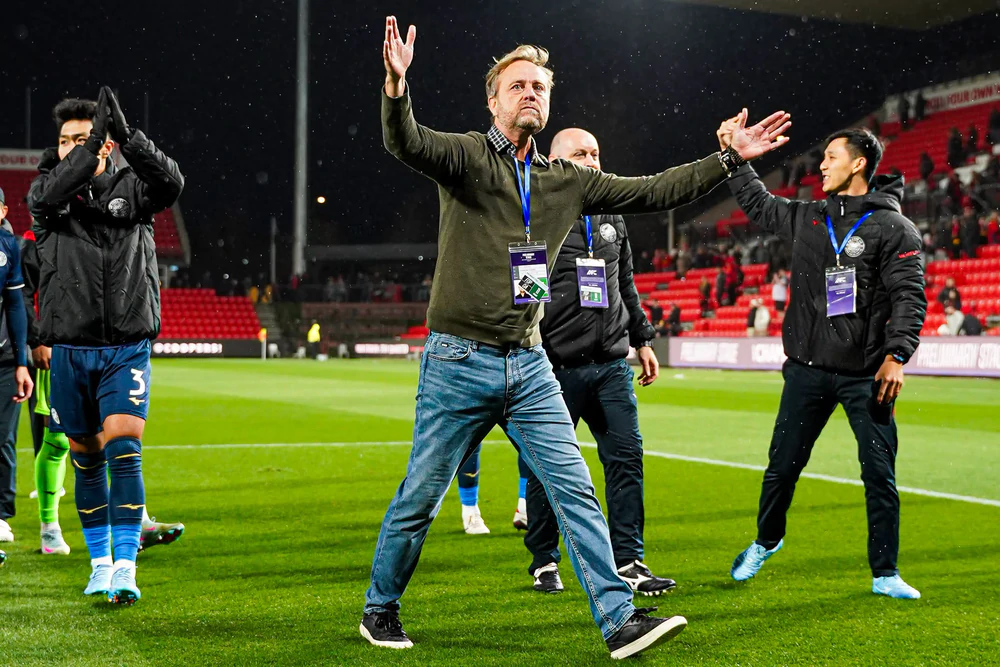
Coach Polking has demonstrated exceptional management and coaching skills by helping CAHN qualify for the group stage of the AFC Champions League Elite 2026/27 despite the absence of six national team players. Photo: CAHN Club
It would be incomplete to view this victory only through the scoreline. The opponent CAHN defeated was Adelaide United, a representative of an A-League currently ranked 4th in Asia (59th in the world) by the Opta Power Rankings, while the V-League is only ranked 14th in the continent and 109th in the world.
The gap in the rankings is so large that, theoretically, this should have been a mismatched match. Therefore, CAHN's elimination of Adelaide United means that in the 2026/27 season, Vietnam and Australia will each have one representative in the League Stage of the AFC Champions League Elite.
More notably, CAHN achieved that milestone under imperfect circumstances. Six key players were busy with the Vietnamese national team at the ASEAN Cup. Coach Mano Polking had to build a different lineup, relying heavily on new foreign players and overseas Vietnamese players. This demonstrates the organizational and managerial capabilities of Coach Polking, rather than just the quality of a few outstanding individuals.
This is very important. Nam Dinh once used up to 11 foreign players on the field but still fell far short in class when facing representatives from Japan or even South Korea. Buying foreign players to "keep up with the Joneses" is just a matter of the financial balance sheet; building a team with consistent standards from coach to players to be competitive on the international stage is a matter of ambition and vision.
The most anticipated outcome from CAHN's performance after the victory in Adelaide is not a single match, but a model. Looking at Thailand and Malaysia, it becomes clear why these two football nations have maintained their leading positions in Southeast Asia for many years: Buriram United has participated in the AFC Champions League group stage 14 times, and Johor Darul Ta'zim (JDT) has 12 appearances.
Among the 16 teams from the East Asian region participating in the AFC Champions League Elite this year, only the "giant" Jeonbuk of South Korea has more appearances. Both Buriram and JDT have advanced past the group stage multiple times. This shows the value of consistent presence.
That is not a random achievement of a single club; it is a "leapfrog" strategy agreed upon by the entire national football system: turning a club into a spearhead carrying a "national mission," bearing the responsibility of demonstrating regional strength on the international stage, just like the role of a national team. When these two spearheads advance together, they can lift the entire football level, at least in terms of AFC points and the number of spots in Asian cups.
Therefore, let us hope that CAHN, with its strong investment, is becoming the Vietnamese version of that model.


Wonderfulshortvideo

mbappe news mbappe edit mbappe new shoe boot deal mbappe nike



julian alvarez barcelona news
James Trafford’s big moment in the U21 EURO final 🤯

RODRI BARCELONA transfer barcelona news today rodri to barcelona transfer here we go
gianni infantino and trump drama news
jorge messi death messi news today football news today
jose mourinho netflix documentary pep guardiola mourinho beef mourinho edit
 Links
Links
 Contact